Showing posts with label landscaping. Show all posts

Thursday, June 9, 2011

Collecting Rain Water–What are the benefits?

By RE/MAX Complete

Collecting Rain Water

What are the benefits?


Can you believe all this rain we have been getting this year?    It has been one wet Spring and the Summer seems to not be much different.  

What can you do with all this rain water that is saturating the areas around our downspouts? 
  
We came across a great article that was featured in the Deseret News on May 7th, 2011, that introduced us to Rain Barrels – water conservation!    Since most of us all have gardens, lawns and flowerbeds, this article by Joe Lampil, host of “Growing a Greener World” on PBS would be of great interest to all of you.
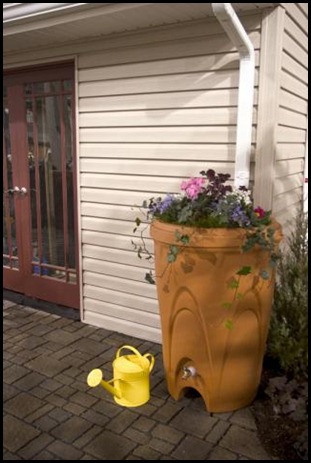

RainXchange%20Rain%20BarrelWEB
“By collecting rain from your roof during wet months and storing it in barrels or tanks, you can create an alternative supply to keep the landscape green without depending on municipal water.   Rainwater doesn’t have the chemicals found in city water, either.   It’s perfect for lawns, flowerbeds and vegetable gardens.

Collectors can be as simple as a rain gutter, downspout and barrel.   There are complete kits available from garden-supply stores, catalogs and the internet, but you can make your own with just a few simple components.  Before getting started, always check local building codes to be sure that rain-collection systems are approved in your area.
  • First, install a wire-mesh or plastic gutter screen where the vertical downspout joins the horizontal gutter.   This will help keep roof debris out of the system.   rainbarrel9
  • Next, select a collection barrel.   Gardening stores sell 55-75 gallon plastic rain barrels, complete with leaf screens and spouts, for $50 to $250.   If you use a recycled barrel, select one that’s been used for food storage rather than any kind of chemical.
  • For safety, barrels must have a sturdy cover that can take the weight of a child who might climb on it.  To keep out mosquitoes and small animals, screen any openings.   During winter months, barrels should be drained or kept only three-quarters full to allow freezing water to expand.
  • Install a heavy-duty plastic drain spigot that can be “welded” into the barrel wall with waterproof plastic cement.  Select one with common-size threads that can attach to an ordinary garden hose, and locate it as low as possible on the side of the barrel.  Place the barrel on a raised platform to make room under the spigot for a watering can or hose attachment, and you’re ready to water.
rainbarrelYou could harvest about 500 gallons of water off a typical 1,000 square foot roof in a storm that produced even 1 inch of rain.   So what to do after the barrels are all full?   Divert the rest of the water into a rain garden.
A rain garden is just a deep depression that collects runoff from impervious surfaces like roofs and driveways and lets it soak slowly into the ground.   they’re planted with shrubs and perennials and maintained like any other landscaped are of your yard.   Place the garden at least 10 feet from the foundation, and no more that 30 feet from the downspout.   Avoid wells, septic systems and low areas that always seem wet.

A typical rain garden needs about 75 to 100 square feet of collecting area, so plan on a 10 by 8 foot flat bottomed bowl 6 inches deep.   The bottom should be fairly level, and the sides gently sloped.   Use the dugout soil to make a retaining berm on the downhill side of a sloped area.”
----If you are interested in more information you can visit: www.joegardener.com.

Friday, June 3, 2011

Showing your home--- Is it like DATING?

By: RE/MAX Complete


DRESS UP YOUR HOME WHEN SHOWING IT!
Article by:  Steve Perry in Deseret News.com  May 14,2011


We came across a great article in the Deseret News on May 14, 2011.   This article was written by Steve Perry, a principle broker.   We though you would enjoy his insight on how showing your own compares to going on a date!


Home buying, it turns out, isn't all that dissimilar from dating.

If a potential buyer notices that your home is good looking on the outside, chances are they'll stick around long enough to see what's on the inside.

Think of your landscaping then as makeup, or nice clothing.  Dressing the part goes a long way toward making a house--or person, I suppose--attractive to anyone.  Part of that is good landscaping.

Green grass, fresh mulch and vibrant colors can bring buyers closer to the front door.  And then your updated appliances, new bathroom or smart layout can help seal the deal.

Often homeowners focus on interior accouterments like big home theaters, super-sized garages or multiple laundry rooms as big selling points and forget that the first impression your home will make is generally the one that buyers will see walking up to the front door.

It's a clever game they're playing, and you can score big if you know how to gussy up your outward appearance.

Trim bushes, maintain driveways and pick weeds.  

*Photo by Buzzle.com*
All of these seem to be no-brainers when it comes to keeping up your home, but how many times did you go out on a date and forget to brush your teeth?   It's the little things that can make a big difference.

And remember also to pay attention to the backyard as well.

If the kitchen is where friends visit first, then the backyard is where friends stay for a while.

Outdoor amenities help buyers visualize what life will be like in their new home--your home.

It's true that outdoor swimming pools and spas can be tricky when it comes to reselling, so it's best to consult US even if you're not selling your home to see if that makes sense for your price range and neighborhood.

*Photo by Prince William County of Virginia *


But adding a brick barbecue and other backyard fixtures could greatly enhance a home's appeal to prospective buyers.

* Photo Marathon Masonry *


Outdoor lighting too can help attract buyers to your home in addition to providing safety and comfort to your outdoor spaces.

When adding, taking away, or enhancing your yards, key in on architectural features of your home.

What would enhance the home rather than feel disconnected?  What's a smart investment for my neighborhood?  What kind of return can I expect when it comes time to sell?

All of these are good questions for a real estate expert to answer.

Making your home look good on the outside isn't nearly as complicated as dating, but it requires just as much preparation.


Wednesday, May 18, 2011

A Landscaped Yard– Do it yourself or have it professionally done?

By:  RE/MAX Complete

Landscape


Having the builder do the landscape of your new home, seems like a huge expense when you look at the $$$ that they are asking, but usually in the long run if you do it yourself, it may cost you more money.


So what are the advantages of having the builder complete the landscape for you?

  • A professional landscaped yard, usually means higher property values
  • Unique design suited for your lot elevation and slope
  • No mud/dirt tracked on your new flooring
  • Peace of mind, knowing that your weekends are not tied up putting the yard in.
  • Kids can immediately go out and play in the yard
  • No major expenses after you move into your home.  Landscape only add just a few more $$$ a month to your loan
  • Your home feels complete and finished

    unlandscaped home

    No matter what you choose to either do it yourself, or have a professional do your landscaping, we hope you enjoy your new home!

    Utah Landscaping Companies:

    Tomorrows Topic:  Secure Fencing
    Hope to see you back tomorrow!

    Thursday, April 28, 2011

    CS on Curb Appeal—Island vs. Peninsula

    By Lori Cartwright


    Hopefully you have a good start on Lawn Care and you are ready to move on to some new curb appeal projects.  A great way to add impact to your landscaping and bring buyers inside your home is to add planting beds for shrubbery and flowers.  Beds that line your house and sidewalk are an obvious choice, but what about landscaping beds known as islands and peninsulas?

    According to Utah Garden Blogs, a landscaping island is a big DON’T for several reasons:
    “Landscape islands are psychologically uncomfortable and often improperly scaled or illogically placed. They go against your natural instincts and often camouflage the architecture landscaping is supposed to enhance. Sometimes, in an effort to avoid hiding the house, they are pushed to the edge of the yard, leaving bits of unusable grass that nevertheless requires a lot of water and maintenance.”
    Instead of an island, consider creating a landscaping peninsula.  What is the difference?  An island is surrounded by grass, whereas a peninsula may be surrounded by grass on most sides, but is anchored to something like a sidewalk or driveway, like this:


    *Image from Utah Garden Blogs


    Here are some more great examples from Better Homes & Gardens.


    If you already have a landscape island, consider the possibility of converting it into a peninsula by anchoring the island to the nearest solid-surface you have.  This may require some grass removal and additional plantings, but the initial effort will pay off in easier maintenance and increased curb appeal..